

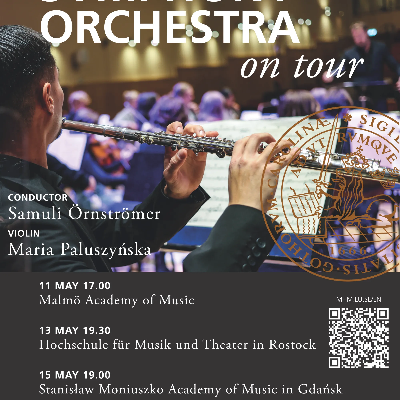
Akademia Muzyczna w Gdańsku zaprasza na wyjątkowy koncert Orkiestry Symfonicznej Akademii Muzycznej z Malmö, która - w ramach europejskiego tournée - ponownie wystąpi w aMuz. Do wspólnego muzykowania zaproszona została także skrzypaczka Maria Paluszyńska. Zaprezentuje się ona w roli solistki w koncercie Maxa Brucha. W programie wieczoru znajdą się: Émilie Mayer - Uwertura do Fausta (polskie prawykonanie), Max Bruch - Koncert skrzypcowy g-moll op. 26, Antonín Dvořák - VII Symfonia d-moll op. 70. W orkiestrze zagrają także studenci Akademii Muzycznej w Gdańsku oraz Hochschule für Musik und Theater w Rostocku. Koncert ten to nie tylko ważne wydarzenie artystyczne, ale także dowód na siłę międzynarodowej wymiany kulturalnej i edukacyjnej. Młodzi muzycy, kształceni w różnych krajach, spotkają się na jednej scenie, by wspólnie tworzyć głębokie, poruszające interpretacje dzieł wybitnych kompozytorów romantyzmu. To muzyka ponad granicami - w imię wspólnoty, pasji i artystycznej wymiany.
Miejsce:
Sala Koncertowa Akademii Muzycznej w Gdańsku, ul. Łąkowa 1-2
wstęp na bezpłatne wejściówki
Wykonawcy:
Maria Paluszyńska - skrzypce
Orkiestra Symfoniczna Akademii Muzycznej w Malmö
Samuli Örnströmer - dyrygent
Program:
E. Mayer - Faust Ouverture (gdańskie prawykonanie)
M. Bruch - I Koncert skrzypcowy g-moll op. 26
A. Dvořák - VII Symfonia d-moll op. 70
Prowadzenie:
Barbara Marwińska-Hansson
Franciszek Rusek
Koordynator:
dr Mirosław Pachowicz
Organizator:
Akademia Muzyczna im. Stanisława Moniuszki w Gdańsku
Współorganizator:
Lunds University, Malmö Academy of Music
Hochschule für Musik und Theater Rostock
__________________
Emelie Mayer (1812-1883): Faust Overture
The Faust Overture, Op. 46 belongs to Mayers later works. It was published in 1880 and became one of Mayers most celebrated works and helped establish her place in concert programmes. At this time, Berlioz, Gounod, Liszt, Schumann, and Wagner had also created successful musical interpretations of the same literary source.
Unlike the more classical orchestral scoring she used in most of her works, Mayer here employs a relatively large brass section. This lends the overture a darker sonority that connects well with the works programmatic character. A direct reference to Goethes text appears towards the end, at rehearsal letter N, where Mayer notes in the manuscript that she is saved, referring to Gretchen, the female protagonist in Faust.
Max Bruch (1838-1920): Violin Concerto No. 1 in G minor, Op. 26
I Vorspiel. Allegro moderato
II Adagio
III Finale. Allegro energico
Towards the end of his career, Bruch witnessed how musical developments moved in directions quite different from his own, and how his works increasingly came to be seen as oldfashioned, gradually disappearing from the repertoire. One important exception, however, was his First Violin Concerto of 1866, whose popularity has instead continued to grow; today it is regarded as one of the most beloved works of the Romantic concerto repertoire.
Bruchs violin concerto is characteristic of the lyrical Romantic concerto, with Mendelssohns violin concerto as a clear point of reference. Singing, cantabile lines lie at the heart of the work, and the violins full expressive range unfoldssometimes discreetly accompanied by the orchestra, sometimes intimately woven together with it in the kind of melodic flow that is typical of Bruchs style.
Antonin Dvořák (1841-1904): Symphony No. 7 in D minor, Op. 70
I Allegro maestoso
II Poco adagio
III Scherzo: Vivace
IV Finale: Allegro
The performance of Brahmss Third Symphony in 1883 made a profound impression on Dvořák and inspired new ideas for his own symphonic writing. Before long, a concrete opportunity arose when the Royal Philharmonic Society in London elected him an honorary member and simultaneously commissioned a new work. The result was the Seventh Symphony.
The music is marked by an unusually strong dramatic power and darker character for Dvořák, combining expressive intensity with a clear, concentrated form and colourful instrumentation. The similarities with Brahmss Third Symphony are at times so striking that they occasionally approach melodic quotation. Yet the work remains one of Dvořáks most personal, and it was with this symphony that he truly began to be regarded as one of the leading symphonists of Central Europe in his time.
__________________
Maria Paluszyńska
Soloist Bruchs Violin Concerto No. 1
Maria Paluszyńska is a Polish violinist currently pursuing her Bachelors degree at the Stanisław Moniuszko Academy of Music in Gdańsk in the class of Prof. Karolina Piątkowska-Nowicka. After winning an audition at her home academy,
she is now the soloist on Max Bruchs First Violin Concerto, which she will perform with Malmö Academy of Music Symphony Orchestra on Tour.
Maria is a laureate of aroud 20 national and international competitions, including First Prize at the World Open Music Competition in Belgrade (Serbia), Second Prize and Honourable Mention at Talents for Europe in Dolný Kubín (Slovakia), and Second Prize at the National Violin Confrontation in Gdynia (Poland). She has performed as a soloist with the Feliks Nowowiejski Music School Chamber Orchestra and Camerata Gedania.
An active chamber musician, she performs in various ensembles and has received numerous awards at international chamber music competitions. She has participated in masterclasses with artists such as Agata Szymczewska, Janusz Wawrowski, Roland Baldini, Eugeniy Chevkenov, Sebastian Hamann, Michał Grabarczyk, and Tim Frederiksen.
Maria has extensive orchestral experience, having served as concertmaster of the Feliks Nowowiejski Music School Symphony Orchestra and performed with the Stanisław Moniuszko Academy of Music Symphony Orchestra, Oh!MyScore Orchestra, the DKDM Symphony Orchestra, Nie|Romantyczni, and other ensembles.
She is especially passionate about the Romantic repertoire. Bruchs Violin Concerto No. 1 holds a special place in her artistic life since an early age. She is particularly drawn to its lyrical intensity, expressive warmth, and the rich dialogue between soloist and orchestra.
Samuli Örnströmer
Conductor
Samuli Örnströmer studied at the Sibelius Academy in Helsinki and at the Edsberg Institute of Music in Stockholm, where he received his diploma in cello in 1998.
After completing his studies, he was employed in 2001 by the Malmö Symphony Orchestra (MSO), where he has since served as principal cellist. In parallel with his position in the orchestra, he works as a teacher of cello and orchestral studies at the Malmö Academy of Music.
In addition to his role as an instrumentalist, Örnströmer is also active as a conductor, a path he began already during his studies, receiving instruction from, among others, Jorma Panula. This versatility, combining performance, teaching, and conducting, reflects his musical breadth and deep commitment to music, and each academic year he conducts the Malmö Academy of Music Symphony Orchestra in a major project.
Taken together, Samuli Örnströmer appears as a musician with both deep tradition and modern range, someone who skillfully balances the roles of performing artist, educator, and conductor. With his long-standing presence in the Malmö area, he has become a central figure in its classical music scene, and his dedication to both teaching and concert performance makes him
a valued musician and conductor among both audiences and students.